Arteris Newsroom Search
Sort & Filter
Type
All types
Press Releases
Blogs
Latest News
Topics
AI / Machine Learning (173) Multi-Die (111) Customer (108) Network-on-Chip (NoC) (106) FlexNoC (75) FlexGen (72) Automotive (57) Enterprise Computing (51) Partner (45) Ncore (42) Corporate (36) Cybersecurity (32) Magillem Registers (28) Magillem Connectivity (26) RISC-V Designs (25) Low Power (20) Industrial (19) Cycuity (16) SoC Integration Automation Software (15) NoC Tiling (14) Consumer Electronics (13) Microcontroller (12) ASIL (11) Magillem Packaging (11) Hardware Security Assurance (6) Radix-S/M/ST (6) Aerospace & Defense (5) CodaCache (5) Connected by Arteris (4) Functional Safety (4) Communications (3) Arm Designs (2) RISC-V (2) Safety (2) SIA (2) AI (1) Product Families (1)
Year
Show More
Sort
Latest
Oldest
A-Z
Z-A
429 Results
Sort & Filter
Design & Reuse: Efficient IP Packaging for Today’s SoC Integration
As SoC architectures scale in complexity, managing hundreds of IP blocks consistently from concept through production is critical to avoid costly errors and rework. Standardizing IP descriptions with IEEE 1685 (IP-XACT) and automating packaging ensures interoperability, accelerates design, and promotes
Learn more about post
Semiconductor Engineering: A Smarter Path To Chiplets Through An Enhanced Multi-Die Solution
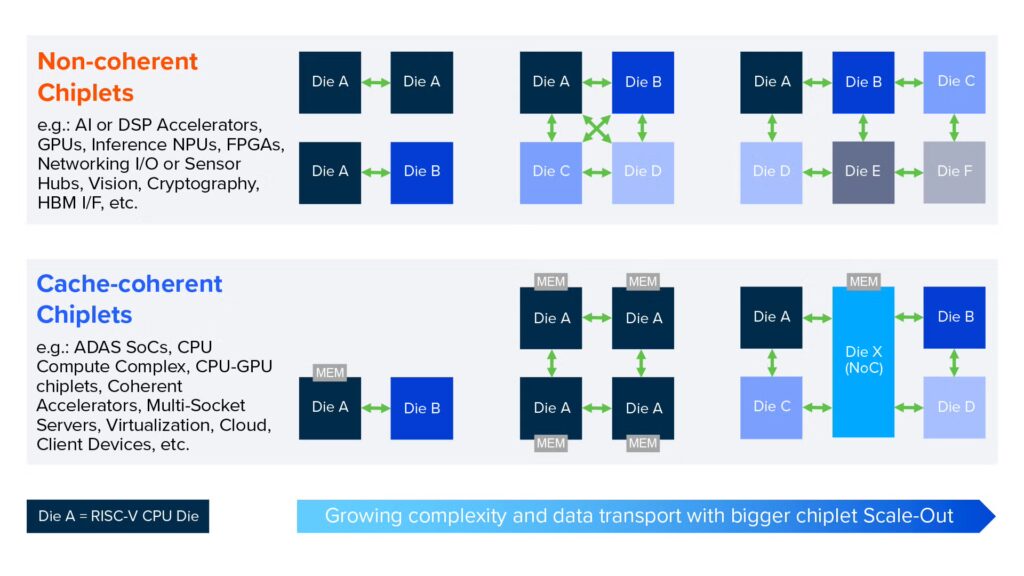
With monolithic SoCs reaching their limits, chiplet-based architectures are key to building flexible, high-performance systems. Arteris’ multi-die solution combines silicon-proven NoC IP, cache coherency, and automation tools to streamline chiplet integration and accelerate time-to-market. Learn more in the article.
Learn more about post
RISC-V: Arteris’ Multi-Die Solution for the RISC-V Ecosystem
As AI, HPC, and automotive workloads push past the limits of monolithic SoCs, chiplet-based design offers a scalable and cost-efficient path forward. Arteris enables this shift with advanced NoC IP for coherent and non-coherent multi-die interconnects, UCIe-based die-to-die links, and
Learn more about post
Semiconductor Engineering: System Integration With Standards-Based Automation
As SoCs evolve into complex multi-die systems, standards-based automation is key. Learn how IP-XACT and Arteris’ Magillem tools enable consistent metadata, scalable IP reuse, and faster, error-free integration across teams and tools.
Learn more about post
EDN: Chiplet design basics for engineers
As AI and HPC workloads intensify, engineers are turning to chiplet-based architectures to overcome the limitations of traditional SoCs. This article explains the fundamentals of chiplet design, its advantages, and the tools enabling scalable, high-performance multi-die systems.
Learn more about post
EE Times: Smarter SoC Design for Agile Teams and Tight Deadlines
Advanced NoC automation helps lean SoC teams meet tight deadlines by reducing complexity, cutting design time, and improving power and performance efficiency.
Learn more about post
Design & Reuse: Enabling Chiplet Design Through Automation and Integration Solutions
Explore how chiplet-based designs overcome SoC limitations. Arteris’ multi-die solution enables connectivity across chiplets, supporting coherent and non-coherent traffic and intelligent dataflow management.
Learn more about post
EDN: Chiplet basics: Separating hype from reality
Planning chiplet-based designs is underway. Yet, uncertainty continues to swirl around chiplet architecture and ready-to-use technologies. New innovations are on the horizon.
Learn more about post
Design & Reuse: Automating NoC Design to Tackle Rising SoC Complexity
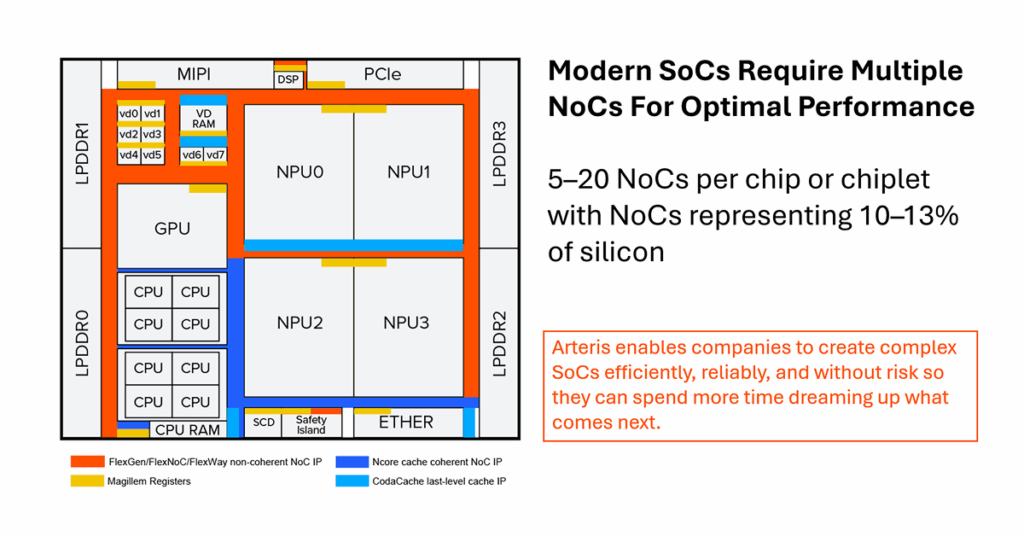
Modern SoCs typically include between 5 and 20 individual NoC instances, consuming around 10–13% of the total silicon area. However, existing methodologies, especially in light of growing register demands, are proving inadequate. This leads to extended development cycles, frequent design
Learn more about post

Semiconductor Engineering: CSR Management: Life Beyond Spreadsheets
The hardware-software interface (HSI) that’s physically represented by control and status registers (CSRs) is a critical source of design risk. Mismanagement of CSRs contributes to a number of SoC failures. To avoid these setbacks, engineering teams need a robust, automated
Learn more about post
Previous
Next Page
No results found
Make sure all words are spelled correctly. Try different, more general, or fewer keywords.