Resources Search
Sort & Filter
Type
Topics
AI / Machine Learning (9) RISC-V Designs (7) Cybersecurity (6) Hardware Security Assurance (5) ISO 26262 (4) Network-on-Chip IP (4) Traceability (4) FMEDA (3) Functional Safety (3) IP-XACT (3) Magillem Connectivity (3) Multi-Die (3) Network-on-Chip (NoC) (3) FlexGen (2) FlexNoC (2) Magillem Registers (2) Power Consumption (2) Radix-S/M/ST (2) Automotive (1) CodaCache (1) Hardware/Software Interface (HSI) (1) Magillem Packaging (1) Ncore (1) Power Management (1) Routing Congestion (1) SystemC (1)
Year
Show More
Sort
Latest
Oldest
A-Z
Z-A
24 Results
Sort & Filter
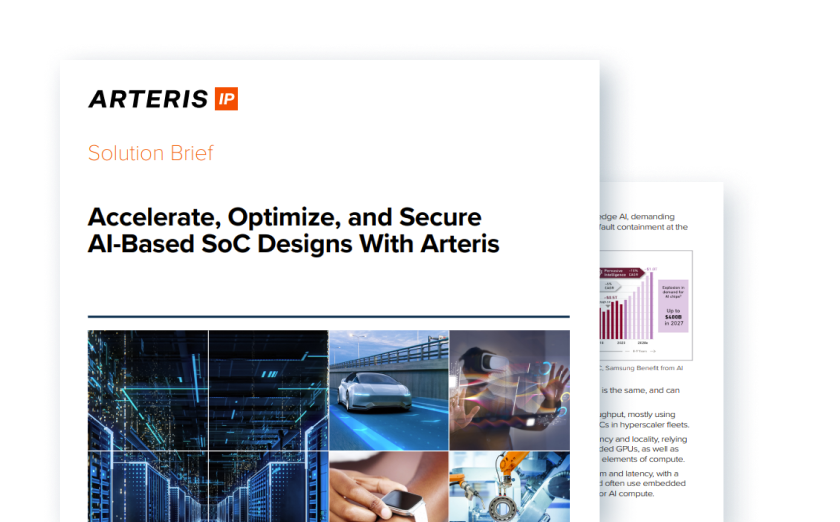
Solution Brief
Accelerate, Optimize, and Secure AI-Based SoC Designs with Arteris
Optimize performance, power, and area for AI-driven SoCs from data centers to edge devices. Enable faster innovation in generative AI, physical AI, and autonomous systems with proven Arteris technology built for scalability, efficiency, and hardware assurance.

White Paper
Power Dissipation of the Network-on-Chip in a System-on-Chip for MPEG-4 Video Encoding
An oldie but a goodie: Explains power benefits of NoC technology by characterizing a multi-processor system-on-chip (MPSoC) for MPEG4, AVC/H.264 encoding. Explains NoC power model used to analyze power consumption and dissipation.
White Paper
Scalability – A Looming Problem in Safety Analysis
Misbehavior in the electronics can lead to accidents, even fatalities. This paper describes how ISO 26262 standard and in particular the Failure Modes, Effects and Diagnostic Analysis (FMEDA) can be leveraged to address this real concern.
Presentation
Automating the Generation of Scalable and Reusable FMEDA in Complex Systems-on-Chip (SoCs)
Presented at IQPC Application of ISO 26262 2022 Conference, describes an approach that uses a hierarchal and modular library of safety components to describe failure modes, safety mechanism diagnostic coverage, and other functional safety metrics at a level that scales with the size and complexity of an SoC and enables reuse for the creation of SoC platform derivative chips, which is common in our industry.
Presentation
Building Better IP with RTL Architect NoC IP Physical Exploration
Voted one of the “Top Ten Best Presentations” at SNUG Silicon Valley 2023, this presentation discusses the importance of NoCs and their impact on timing analysis and power consumption. It introduces a flow and methodology that utilizes RTL-based estimation of timing and power consumption using RTL Architect in conjunction with Arteris’ FlexNoC 5 and Ncore NoC development frameworks. FlexNoC 5 facilitates up to 5X faster physical convergence of the back-end physical design time and effort.
Previous
Next Page
No results found
Make sure all words are spelled correctly. Try different, more general, or fewer keywords.
Popup Overlay